
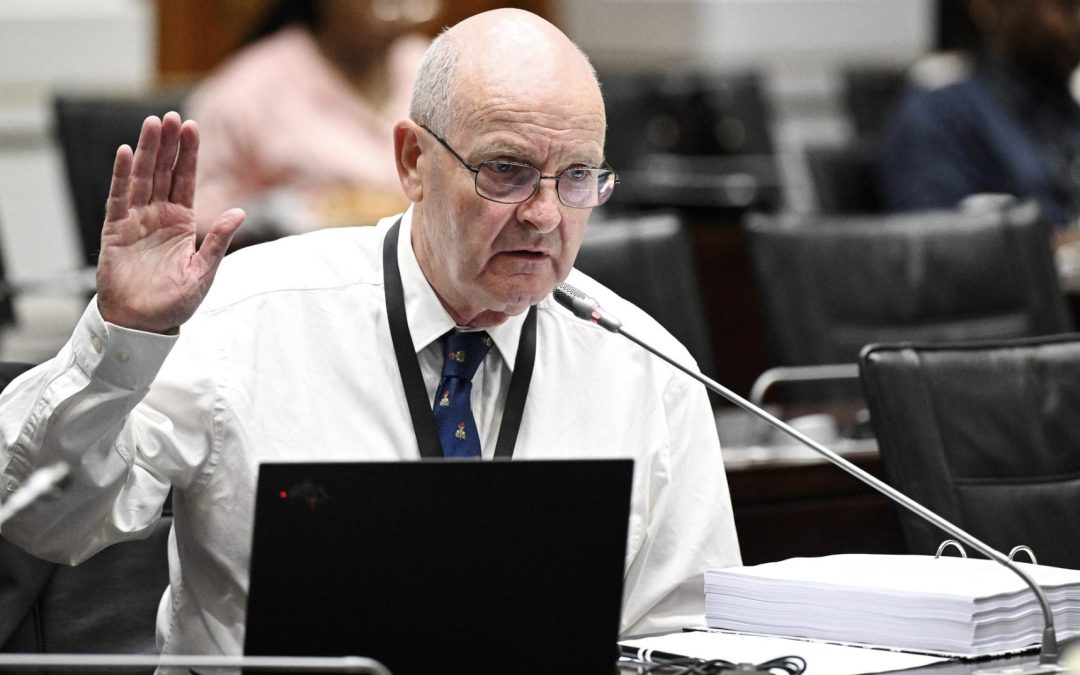
From electrician to anti-corruption crusader: the controversial career of a private investigator whose methods have repeatedly attracted judicial scrutiny.
Employment records, family documents and court decisions trace the investigator’s professional life and the disputes surrounding his conduct.
Paul Robert O’Sullivan, 71, is widely associated with investigations into senior police officials and alleged corruption in South Africa’s criminal justice system. His documentary history begins in electrical contracting and engineering services, moves through property development and corporate security, and includes a succession of marriages and a family of seven children.
It also includes his dismissal from Airports Company South Africa after a prolonged conflict with chief executive Monhla Hlahla, the 1999 criminal case involving his then-wife Odette, and later court orders restraining his conduct. A 2011 interdict secured by an attorney and his firm was followed by a 2013 judgment finding that his conduct towards businessman Neil Diamond amounted to attempted extortion. In 2020, Acting Judge Allyson Crutchfield criticised a forensic report he co-authored and the respondents’ disregard for the accuracy and language of their allegations.
Electrical work and the move to South Africa
O’Sullivan’s date of birth is 26 August 1955 and his birthplace as Kettering, England. They record Irish nationality and subsequent naturalisation as a South African citizen in January 1995. His naturalisation certificate is dated 10 January 1995.
His early curriculum vitae records employment with E. P. O’Sullivan & Sons, a London electrical contractor, from September 1971 to June 1978. It describes progression from apprentice electrician to electrician and then contracts estimator or supervisor. His duties included preparing tenders, purchasing materials and supervising work.
An employer’s reference confirms that he subsequently worked for the London Borough of Barnet from 17 July 1978 to 9 March 1979. It describes him as hardworking, capable and quick to learn. His work involved electrical installations in public buildings. The file also contains a City and Guilds certificate in electrical installation work, awarded in December 1978, and a Technician Education Council certificate in electronics, awarded in July 1980 after study at Oldham College of Technology. These establish technical qualifications rather than university engineering degrees, as O’Sullivan intimated to Parliament in February 2026.
Chubb Fire Security offered him a South African sales engineering position in November 1980. His CV describes fire protection engineering duties, including detection systems, sprinklers and hose reels. The employment ended abruptly. In a letter dated 12 June 1981, Chubb told immigration officials that he had left without notice and without explaining his departure to the company. It believed he might have returned to Britain. The supplied material contains no detailed response from him explaining that departure.
A reference from Wilkinson & Wilkinson, a British building services consultancy, confirms employment from 6 July 1981 to 29 October 1982. It praises his responsibility and attention to detail. His work included electrical design, specifications, tender analysis and supervision of installations.
In 1982, Powell’s Electrical in Johannesburg supported an application to employ him as an electrical engineering technician. Home Affairs correspondence records the refusal of a work permit and his return to England on 3 December 1982. The proposed appointment is therefore distinct from established service with the company.
His efforts to settle produced correspondence with MP Derrick Watterson. In a November 1982 appeal, O’Sullivan praised South Africa as a Christian country and criticised what he called “Communist inspired unions”. Watterson’s supporting letter described him as politically conservative. These documents record his expressed outlook at that time. Permanent-residence permits for O’Sullivan and members of his family followed in November 1989, and naturalisation in January 1995.
Employment chronology
| Period | Employer or activity | Role and evidence |
| September 1971 to June 1978 | E. P. O’Sullivan & Sons, London | Apprentice electrician, electrician and contracts estimator or supervisor, according to his early CV. |
| July 1978 to March 1979 | London Borough of Barnet | Engineering technician; dates and favourable assessment confirmed by an employer’s reference. |
| 1979 to 1980 | Travel and technical study | His CV records African travel and full-time study at Oldham. The periods overlap and do not establish a complete monthly chronology. |
| September to December 1980 | Chubb Fire Security, Dublin | Fire protection engineer, according to his CV. |
| Early 1981 | Chubb Fire Security, South Africa | Sales engineer in appointment documents; fire protection engineer in his CV. Chubb subsequently reported his departure without notice. |
| July 1981 to October 1982 | Wilkinson & Wilkinson, Britain | Electrical engineering work, confirmed by a contemporary reference. |
| Late 1982 | Proposed appointment at Powell’s Electrical | Work-permit application supported by the company; sustained employment is not established. |
| 1981 to 1984 | Consulting building services work associated with IBM UK | Listed in his 2026 CV. Earlier records name Wilkinson & Wilkinson for part of the period; IBM’s relationship to that consultancy work remains unclear. |
| 1984 to 1992 | Property development and investment | British and South African activities, according to his 2026 CV. A 1989 accountant’s statement names him as managing director of Milton Hutchings Limited. |
| 1989 to 1990 | Eastern Province Building Society Property Development Company | Assistant general manager, according to his 2026 CV. |
| 1990 to 1995 | Sage Properties | Assistant general manager in property management, according to his 2026 CV. His naturalisation application also names Sage as his employer. |
| 1995 to 1997 | Chubb Security Limited | Country manager, according to his 2026 CV; separate from the earlier Chubb Fire appointment. |
| 1997 to 2001 | Property development companies | Managing director, according to his 2026 CV, which does not identify every company. |
| 25 July 2001 to 31 January 2003 | Airports Company South Africa | Group Executive Aviation Security, as described in his particulars of claim. The termination letter documents his departure. |
| From 2003 | Property and forensic businesses | His public career increasingly centred on private investigations. |
| 2015 | Forensics for Justice | His 2026 CV records the organisation’s founding that year. |
Odette and the 1999 criminal case
The earliest marriage documented was to Donna Mary Wilson. His naturalisation application gives their marriage date as 10 March 1984. Immigration records identify their daughters as Roisin Ann and Sinead Clare.
By January 1996, O’Sullivan was preparing to marry Odette Tjaden. Their antenuptial contract, signed on 29 January, describes him as divorced and her as a “minor spinster”, assisted by her mother and legal guardian. Odette, born on 15 November 1977, was 18; O’Sullivan was 40. The contract records an intended marriage and does not itself establish the wedding date.
In 1999, O’Sullivan was convicted of assaulting Odette, breaching an existing restraining order, maliciously damaging her motor vehicle and crimen injuria. Odette was 21 at the time.
The Linden docket contains statements from Odette, her mother, Gerhard Smit and his mother, Rachell Smit. Odette said that on the evening of 11 August 1999 she was visiting Gerhard Smit when O’Sullivan arrived, shouted at her and struck her on the head, ears and mouth. She said he threw her to the ground and reached for or began drawing his firearm. She alleged subsequent threats against her mother and her friend, and a threat to have her pilot’s licence taken away.
Gerhard Smit’s statement corroborated an assault. He described O’Sullivan slapping Odette, punching her in the mouth and kicking her while she was on the ground. He said he tried to intervene and that O’Sullivan also attempted to strike him. Rachell Smit separately described repeated blows, Odette falling to the ground and bleeding from the mouth. She said she called the police.
In a supplementary statement, Odette said O’Sullivan had scratched the word “SLUT” into the right rear door of her Ford Fiesta. She supplied a repair quotation of R2,820. She also described repeated abusive messages and continued contact after he had appeared in court, despite her wish that he stop contacting her. Her mother placed the events in the context of a protection order obtained in July 1999 and alleged further abusive calls and threats.
These statements describe physical violence, intimidation and degrading abuse during the breakdown of the marriage. O’Sullivan later described the matter as involving an admission-of-guilt fine and said the resulting criminal record had been expunged. That is his subsequent account of the historical proceedings.
ACSA and the breakdown with Monhla Hlahla
O’Sullivan joined the Airports Company of South Africa (ACSA) in July 2001. The correspondence documents an increasingly antagonistic relationship with chief executive Monhla Hlahla over management authority, security policy, communication and performance.
A January 2002 letter records discussions about threatening conduct, alleged sexual harassment and an investigation at Durban Airport. These were described as matters under investigation rather than completed findings. By July, disagreement concerned security screening and relations with the Civil Aviation Authority, South African Airways and the police. O’Sullivan circulated an email distancing himself from a meeting and warning of the company’s exposure.
Hlahla’s response indicates that she regarded his approach as undermining collective management. She accepted responsibility for decisions taken on her behalf and objected to what she understood as an attempt to embarrass colleagues while separating himself from their actions. A September exchange concerning an X-ray equipment project shows a further dispute over responsibility. Hlahla criticised his planning, the late submission of documents and what she perceived as a threat to hold her responsible for delivery delays.
The conflict culminated in her dismissal letter of 31 January 2003. Hlahla wrote that repeated attempts to correct his conduct, attitude and performance had failed. She described incompatibility, hostility, aggression and rudeness towards herself and the company. The letter records his proposal to report to Carmine Bassetti instead of her. Hlahla rejected it because she believed it would reinforce his unwillingness to accept her authority. She terminated his employment on three months’ notice, paid instead of worked, and instructed him to leave that afternoon.
The correspondence supports describing the relationship as confrontational and, in Hlahla’s documented assessment, marked by resistance to her authority.
O’Sullivan disputed the company’s account. In March 2003, he brought a R20 million defamation claim against ACSA and Hlahla, alleging damage to his reputation and employment prospects. He later alleged that Hlahla and police commissioner Jackie Selebi had conspired to secure his dismissal. Those were his allegations, rather than findings established by the supplied bundle. His hostility continued after his departure: in a 2010 interview he said he intended to take Hlahla to court and make her account for her conduct. The final outcome of all the dismissal-related litigation is unknown.
O’ Sullivan has publicly stated that his contract was terminated because he could not get a security clearance, on account of the fact that he was not born in South Africa. This is untrue. The security clearance was not renewed when it was established that he had failed to disclose that he was in 1999 convicted of gender-based violence, assault, malicious injury to property, crimen injuria, and contempt of court. The last charged being in respect of a previous domestic violence interdict that was granted against him.
The BDK interdict and apology in 2011
In March 2011, attorney Pieter du Plessis and the firm David H Botha du Plessis & Kruger approached the South Gauteng High Court over O’Sullivan’s conduct. The dispute arose from an email headed “You have crossed the line”, sent on 29 March in connection with the firm’s representation of Radovan Krejčíř .
The email imposed a 24-hour deadline and threatened action against the attorney and his business. It also referred to people close to him and raised the possibility of passing personal information to Krejčíř‘s enemies. Those accusations and insinuations were O’Sullivan’s statements, not facts established against the attorney or firm.
Judge Willem Wepener granted interim relief on 29 March 2011. The order restrained O’Sullivan from assaulting, harassing, threatening, intimidating or verbally abusing Du Plessis, his family, and the firm’s employees or directors. It also restrained him from inciting others to engage in such conduct. [8, pp. 1-2]
On 7 June 2011, Judge Margret Victor made the agreed draft order an order of court. It confirmed those restraints and made them final, noted the settlement agreement and directed each side to pay its own costs. This was a final interdict by agreement, rather than a criminal conviction or a judgment after a contested determination of every underlying allegation.
In the settlement, O’Sullivan unreservedly apologised to Du Plessis, the family members mentioned in the email and the firm’s directors for its contents and the manner in which they had been formulated. He maintained that he had not intended a threat, but conceded that the email had reasonably been interpreted as one. He specifically apologised for involving Du Plessis’s wife in a dispute that had no bearing on her.
He also acknowledged the constitutional right of accused persons to legal representation and the importance of protecting that right. The agreement added that all participants, including attorneys, remained subject to the law. The settlement finally resolved claims arising from the email and subsequent actions and was intended to serve as a mutual press release.
Neil Diamond and a finding of attempted extortion
A separate dispute brought O’Sullivan before the same High Court in Diamond v O’Sullivan and Another, case 45270/12. The judgment was delivered by Acting Judge Craig Watt-Pringle on 18 July 2013. Diamond was the applicant; O’Sullivan and Annelien van der Walt were the respondents.
The case arose from an estate dispute. Diamond had acted as executor of the estate of his friend; the late Jannie van der Walt. O’Sullivan and his employee, Melissa Naidu, now of Toronto, Canada, approached him on behalf of the widow, the second respondent. Diamond alleged that O’Sullivan threatened arrest and damaging publicity unless he cooperated over repayment of money said to belong to the estate. O’Sullivan disputed the aggressive characterisation and denied unlawful threats or extortion.
Central to the case was a recording of their meeting on 28 November 2012. Judge Watt-Pringle heard the recording and found that, apart from insignificant differences, the transcript accurately reflected the meeting. The judge rejected efforts to exclude it and refused applications for postponement and for his recusal.
The court found that O’Sullivan sought an undertaking to repay money while refusing to disclose the precise amount and declining to engage meaningfully with Diamond’s explanation. It characterised his approach as bullying and overbearing. The finding concerned the use of threatened consequences to secure concessions, rather than a determination that Diamond had committed theft.
Judge Watt-Pringle found that O’Sullivan’s conduct was unlawful and amounted to attempted extortion. Paragraph 63 explained that Diamond’s failure to submit to the threats meant the conduct was attempted rather than completed extortion. The judge also found unlawful harassment and described the pressure as taking the law into his own hands.
The judgment explicitly considered the earlier BDK interdict and apology. Judge Watt-Pringle regarded that history as relevant to the risk of repetition and the claim for punitive costs. The court ultimately restrained both respondents from threatening, harassing, intimidating or abusing Diamond, inciting others to do so, and stalking him or entering his business premises. They were ordered jointly and severally to pay costs on the attorney-and-client scale.
The forensic report criticised by Judge Crutchfield
In Mostert and Another v Nash and Others, decided on 28 July 2020, Acting Judge Allyson Crutchfield examined a report co-authored by O’Sullivan and Sarah-Jane Trent for Simon Nash. The applicants were Antony Louis Mostert and the Power Pack Pension Fund in liquidation. O’Sullivan, Trent and his company were respondents alongside Nash.
The dispute concerned allegations about Mostert and Old Mutual agreements. The respondents relied on truth, public interest and freedom of expression.
She wrote:
[98] Moreover, the forensic report does not contain facts and the averments that the forensic report does contain are substantially false. The respondents do not make out a case that the contents of any future version of the forensic report will be different or anything other than substantially untrue.
[99] The respondents’ statements regarding the applicants reflect an absence of concern on the part of the respondents, not only with the truth or correctness of those statements but also with the language used to express them.The order restrained publication of false defamatory allegations and the report, including variations, pending contemplated action proceedings. That relief was conditional on proceedings being instituted within one month; a separate restraint concerned dealings with potential witnesses pending the Power Pack action. The court awarded attorney-and-client costs.
Mostert is also presently suing Nash, O’Sullivan, Trent and Paul O’Sullivan & Associates for R50 million for defamation.
Brigadier Dineo Mokwele and the Crime Intelligence investigation
O’Sullivan’s intervention
Paul O’Sullivan’s intervention in the controversy concerning Brigadier Dineo Mokwele, appointed to head Technical Support Services within the South African Police Service’s Crime Intelligence division, came under scrutiny during the Madlanga Commission of Inquiry in 2026. Mokwele’s appointment took effect in November 2024. Investigators subsequently alleged that the appointment was irregular and that senior police officers had manipulated the recruitment process. Mokwele, Crime Intelligence head Lieutenant-General Dumisani Khumalo and five other officers were arrested on 26 June 2025 in connection with allegations of fraud and corruption. Those allegations were disputed.
According to evidence attributed to senior Investigating Directorate Against Corruption (IDAC) investigator Mantsha Raphesu before the commission, O’Sullivan emailed Mokwele on 5 January 2025 and gave her fourteen days to supply records concerning her appointment, resign from the police, repay remuneration he regarded as improperly received and confirm her resignation in writing. He reportedly suggested she return to BMW, her former employer. The reported email was copied to several public officials, including IDAC head Advocate Andrea Johnson. These are accounts of O’Sullivan’s communication; they do not establish that he directed IDAC or caused the subsequent arrests.
Qualifications and the commission evidence
Evidence reported from the Madlanga Commission hearings indicated that Mokwele had technical qualifications, including qualifications in mechatronics and industrial engineering, relevant to the work of the post. In July 2026, Johnson reportedly acknowledged that she had not personally reviewed Mokwele’s curriculum vitae and supporting qualifications before relying on assertions that she was unqualified. She withdrew a description of the appointment as a token appointment and apologised. The testimony raised substantial concerns about the evidential foundation of the prosecution.
The existence of relevant qualifications did not independently resolve every issue concerning recruitment procedure, experience, vetting or the lawfulness of the appointment. Nor did admissions before the commission amount to a final court determination of those administrative questions.
Withdrawal of the charges
The charges were provisionally withdrawn in July 2026. On 21 August 2026 the prosecution against Mokwele, Khumalo and their five co-accused was withdrawn unconditionally. Reporting attributed the decision to the National Prosecuting Authority’s review of representations, the evidence and disclosures at the Madlanga Commission. Re-enrolment was reported to require written approval from the National Director of Public Prosecutions. Withdrawal of the case was not a criminal acquittal after trial, nor a judicial resolution of all allegations concerning the appointment. Mokwele subsequently indicated that she was considering legal action against the state.
Questions about investigative methods
The website previously characterised O’Sullivan’s approach to Mokwele, alongside earlier disputes involving women, as evidence of misogyny. That is the website publisher’s interpretation, not a judicial finding or a conclusion established by the Madlanga Commission. The documentary question is narrower: O’Sullivan reportedly demanded resignation and repayment before a court had determined the appointment to be unlawful.
The episode invites comparison with Diamond v O’Sullivan and Another, in which a civil court found in 2013 that O’Sullivan had attempted to obtain concessions through unlawful threats. But no equivalent finding of attempted extortion, harassment or intimidation has been established against him in the Mokwele matter. The public record examined here does not establish what appointment documents he had seen when he sent his email, whether he later revised his assessment, or whether his representations influenced the decision to prosecute. Those questions remain unresolved.
The Dudu Myeni affair: forged bank statements, demands and an apology
The Myeni episode is relevant to the wider pattern examined in this profile: O’Sullivan sought immediate action by a prominent public official on the strength of documents whose authenticity had not yet been established. When the documents proved false, he recanted and offered compensation. It remains important to distinguish his admitted error and the documented settlement proposal from the much more serious legal conclusion that he committed extortion, which was not established by a criminal conviction in this matter.
There was a further, distinct outcome. In January 2019 O’Sullivan and ENSafrica settled a dispute in which he accused the law firm of having contributed to his arrest and prosecution. ENS denied wrongdoing. Daily Maverick later reported that ENS paid him R3.5 million, without admission of liability, and that he agreed to stop making specified allegations against the firm. Myeni was not a party to that settlement. The later payment to O’Sullivan must not be conflated with his earlier R50,000 offer to Myeni.
The episode gave rise to criminal allegations. A submission concerning prosecutors presented to the Zondo Commission records that O’Sullivan and two co-accused faced charges of extortion and criminal defamation arising from the demands and threatened disclosure. It also records that those charges were withdrawn and remained withdrawn at the time of the submission. That source argued that a prima facie case had existed; its argument is not a criminal court’s finding of guilt. O’Sullivan maintained that he had been misled by false documents and later disputed the prosecution.
Correspondence reported by the Sunday Independent records O’Sullivan proposing, on a without-prejudice basis, a payment of R50,000 to Myeni in recognition of the stress caused by his communications, as well as R25,000 towards SAA’s legal and investigative costs. This was a proposed solatium or settlement offer; the reviewed material does not establish that Myeni accepted or received the R50,000.
By the afternoon of 25 February, inconsistencies in the records were being identified. O’Sullivan issued a cautionary message and subsequently acknowledged that he had relied on fabricated documents. In a contemporaneous interview he accepted that he had made an error and owed Myeni an apology. Attorney George van Niekerk, acting for Myeni and SAA through ENS, publicly said that checks with the purported banks indicated that the documents were forged and that the matter had harmed Myeni.
Contemporary reporting establishes that O’Sullivan emailed Myeni at about 10:02 on 25 February 2015. He suggested that two supposed offshore accounts reflected more than R250 million and might be associated with the SAA wide-bodied aircraft procurement and Gauteng e-toll contracts. He called for her resignation if the accounts were hers and demanded that she end what he characterised as an unlawful campaign against Kalawe. A later account of the criminal case, provided to the Zondo Commission, stated that his communication threatened publication unless Myeni resigned, abandoned disciplinary proceedings against Kalawe and reinstated him as chief executive.
The supplied affidavit by O’Sullivan, dated 7 March 2015 and lodged under Bramley CAS 94/3/2015, records O’Sullivan’s account of receiving the images from Kalawe on 25 February. He said the material purported to have been obtained through Interpol and indicated accounts containing considerable sums. In the statement, O’Sullivan maintained that he had later identified the records as false and opened a complaint of fraud and forgery against Abednego Mbulawa, whom he alleged had supplied them to Kalawe. His annexed notes record Kalawe’s account that R150,000 had been paid for the supposed evidence. These are allegations and accounts in the sworn statement, not findings against Mbulawa.
In February 2015, O’Sullivan became embroiled in an attempt to expose alleged corruption by South African Airways (SAA) chairperson Duduzile “Dudu” Myeni. The episode began when suspended SAA chief executive Monwabisi Kalawe supplied him with images of documents purporting to show substantial holdings in foreign bank accounts in Myeni’s name. The documents were subsequently exposed as forgeries. O’Sullivan withdrew his allegations, apologised and offered Myeni R50,000 in proposed compensation. It is unknown whether O’Sullivan did make payment to Myeni.
Ramaphosa reservist training and the Africa Check findings
Africa Check’s 10 June 2022 investigation establishes a specific link between O’Sullivan and Cyril Ramaphosa: an undated newspaper clipping identifies O’Sullivan as “lecturer, police reservist and businessman” and as Ramaphosa’s trainer. It records Ramaphosa receiving the “Most Conscientious Student” award at Houghton Reserve Police College.
The fact-check rejects a viral claim that the photograph showed Ramaphosa receiving an award as an apartheid policeman. Africa Check dates the clipping to 1997 or later from the business positions it lists, placing it after the 1994 democratic transition. It distinguishes volunteer reservist training from full-time police employment. The original clipping remains undated; this is a conclusion about its earliest possible publication, not a verified issue date.
The account supports O’Sullivan’s historical role as a reservist instructor. It does not establish that he originated or endorsed the false social-media claim, nor does a training relationship alone establish subsequent political influence or preferential access.
A separate BizNews interview published on 19 December 2017 corroborates the training connection through O’Sullivan’s own account. He recalled training Ramaphosa approximately twenty years earlier and described himself as the head lecturer at the Houghton reservist training centre. That recollection supports the relationship while remaining his account of his own role.
The Sakina Kamwendo interview and criticism of his conduct
On 31 October 2022, O’Sullivan’s telephone interview with SABC Morning Live anchor Sakina Kamwendo ended when he cut the call during follow-up questions about the Phala Phala affair. SABC subsequently reported that he had rejected Arthur Fraser’s allegation that his private investigation company helped trace people suspected of stealing foreign currency from Ramaphosa’s farm. Fraser’s allegation was disputed by O’Sullivan; the interview did not establish its truth.
According to contemporary reporting by Jonisayi Maromo, O’Sullivan said he first learned of the burglary through the media in June 2022. Kamwendo pressed him about when he began examining presidential protection head Wally Rhoode’s finances and what supported his claims. He objected: “Who do you think you are talking to?” He accused her of trying to implicate him and threatened to end the conversation. Kamwendo defended her right to ask questions. The call then ended. These details are reported accounts of the exchange, rather than findings about the underlying Phala Phala allegations.
The Economic Freedom Fighters condemned his treatment of Kamwendo in a statement issued that day, describing his language as “bullying and intimidatory” and alleging a racist attitude. It praised her measured questioning and urged the SABC to defend her. The party also criticised what it regarded at that time as silence from the broadcaster and the South African National Editors’ Forum. Those descriptions and accusations were the EFF’s political assessment, not judicial findings or statements issued by SANEF. Its additional allegations of a cover-up do not establish that O’Sullivan participated in one. [33]
The criticism extended to public support for the interviewer: Maromo reported that the hashtag #IStandWithSakina was gaining momentum. The exchange illustrates a tension relevant to this profile: an investigator making allegations about others resisted follow-up scrutiny of his own account and terminated the interview.
Public investigative career
O’Sullivan became widely associated with the investigation of Selebi, who was convicted of corruption in 2010. Reporting described him as a driving force behind the case. Selebi’s conviction does not establish the truth of every separate allegation O’Sullivan made about ACSA or Hlahla.
His investigative activities also brought repeated confrontations with police and prosecutors. In April 2016, he was removed from an aircraft while travelling with two daughters and arrested over his use of a foreign passport. The citizenship-related prosecution was dismissed in June 2017; his attorney attributed the dismissal to insufficient evidence and witnesses. In February 2026, he defended his activities before a parliamentary committee and denied being a foreign agent.
Later marriages and his family
Public records document his marriage to Irina Ivanovna, whose surnames appear as Derevnina and Stepanova, on 26 July 2004 in Kensington, Johannesburg. The file contains orders recording his adoption of her sons Matvey and Anton in April 2006. A British birth certificate identifies Irina as the mother of Mary Jane O’Sullivan, born in September 2007. His published account also identifies a daughter Anna, born in South Africa in 2006.
A marriage certificate records his marriage to Viktoria Sharko on 8 March 2012 in Johannesburg. A population-register extract supplied in February 2026 still records that marriage. The file contains a July 2015 order recording his adoption of Regina, Viktoria’s daughter.
Together with Donna and Odette, these records identify four women as wives across different periods. A 2018 Sunday Times profile described three marriages and seven children. Its marriage count requires reconciliation with the documentary history.
All ages below are calculated as at 31 October 2026.
| Wife or former wife | Birth information | Age |
| Donna Mary Wilson | May 1963 | 63 |
| Odette Tjaden | 15 November 1977 | 48 |
| Irina Ivanovna also recorded as Derevnina or Stepanova | June 1975 | 51 |
| Viktoria Sharko | September 1975 according to the marriage certificate | 51 |
Odette turns 49 on 15 November 2026.
| Child | Birth information | Age |
| Roisin Ann O’Sullivan | October 1987 | 39 |
| Sinead Clare O’Sullivan | April 1989 | 37 |
| Matvey O’Sullivan | March 1999 | 27 |
| Anton O’Sullivan | June 2000 | 26 |
| Regina O’Sullivan | April 2002 | 24 |
| Anna O’Sullivan | 2006 exact birthday not established | 19 or 20 |
| Mary Jane O’Sullivan | September 2007 | 19 |